Can kids still learn patience in a world designed for instant gratification? They can when given the right skillset.
By: Ali Suranovic Stoner | Friendzy Lead Content Developer
Students today have never known a world without the internet, social media, or an automation for just about anything. The result: an entire generation that's grown up in a culture of instant gratification. So, can kids still learn patience and self-control skills? At Friendzy, we believe they can—when given the right tools.
Maeve’s phone alarm rings and buzzes a familiar tune, which she quickly silences. She is a seventh grader on the first day of school and groans as her snooze window ticks by. Reluctantly, she gets out of bed and begins getting ready for the day. While she’s brushing her teeth, Maeve checks the usual apps to see how many comments came through from her end-of-summer story. She quickly gets sidetracked by a video, and the scrolling begins.
On her walk to school, she shuffles through a playlist made by a friend, skipping songs after just a few seconds, unable to find one that is just right. During first period, her teacher almost seems to be speaking in slow motion, and Maeve wonders if this is a sign of what’s to come for the rest of the year. Math is a quick review of last year’s skills. Maeve sits with pencil in hand, struggling to concentrate on a multi-step problem that used to come easily to her. She finds her mind drifting and wishes she could check her phone.
Living in a culture of instant gratification might look and feel a lot like Maeve’s day. With access to more content than ever (information, music libraries, streaming services, and social media apps), students expect immediate rewards. The days of waiting a whole week for the next episode or for your friend to RSVP to your birthday party are long gone.
The implications in the classroom are stark. Students may exhibit less self-control, have a shorter tolerance for challenging tasks, and show less perseverance through multi-step problems.
Instant gratification is the “pleasure or satisfaction that you get from something immediately, without having to wait or work hard to get it.”1 Real learning is not accomplished with instant gratification, but with focus, perseverance, questioning, and collaboration.
Self-control skills are needed now more than ever. That’s where educators come in! Below are four resources to use with your students to support their development of self-control.
Help students take ownership of their learning by introducing the S.M.A.R.T. goal-setting framework with the Friendzy S.M.A.R.T. goal-setting guide and student activity. Teaching goal-setting strategies enhances a student’s self-management skills while also fostering self-awareness and responsible decision-making.
High School students can use the S.M.A.R.T.E.R. goal tool, which encourages them to evaluate and reflect on their progress, allowing them to take steps to achieve their goals along the way.
The Daily Check-in Tool is an emotions chart that creates space for students to practice self-awareness through identifying their emotions. Use this brief daily exercise to make a big difference in your students’ overall well-being. When you talk about emotions every day, you are increasing every student’s emotional literacy and teaching them that emotions are temporary and can vary in intensity. This will lead to greater academic success and coping skills! See below for a variety of formats available in English and Spanish.
English
Spanish
Breathing exercises help students regulate their emotions and calm down. These are helpful strategies for students of any age.
Although it might feel like you can’t compete with the instant gratification students have at their fingertips, you can provide them with concrete, practical strategies to improve their self-control.
At Friendzy, our approach to character development education is deeply rooted in faith in action. We believe these aren’t merely "soft skills," they're skills for good, skills for life.
We teach students that emotional awareness means engaging with critical thinking, being intentional, and staying rooted in their identity in Christ—even amid uncertainty.
Ready to strengthen your school’s character education and faith foundation this fall? Learn more about Friendzy’s program for faith-based schools and discover tools that support whole-child formation rooted in Biblical truth.
Let’s work together to empower your staff and students with skills for good, skills for life.
This unit will help students of all ages identify and regulate their emotions. Students will learn about different parts of the brain and what happens when we feel different emotions. They will practice coping strategies and be introduced to Friendzy’s Daily Check-in Tool, an emotion chart that supports self-awareness.
Use I Manage Me’s lessons to close out the year or when you start fresh in the fall! Lessons should take 20-40 minutes of class time.
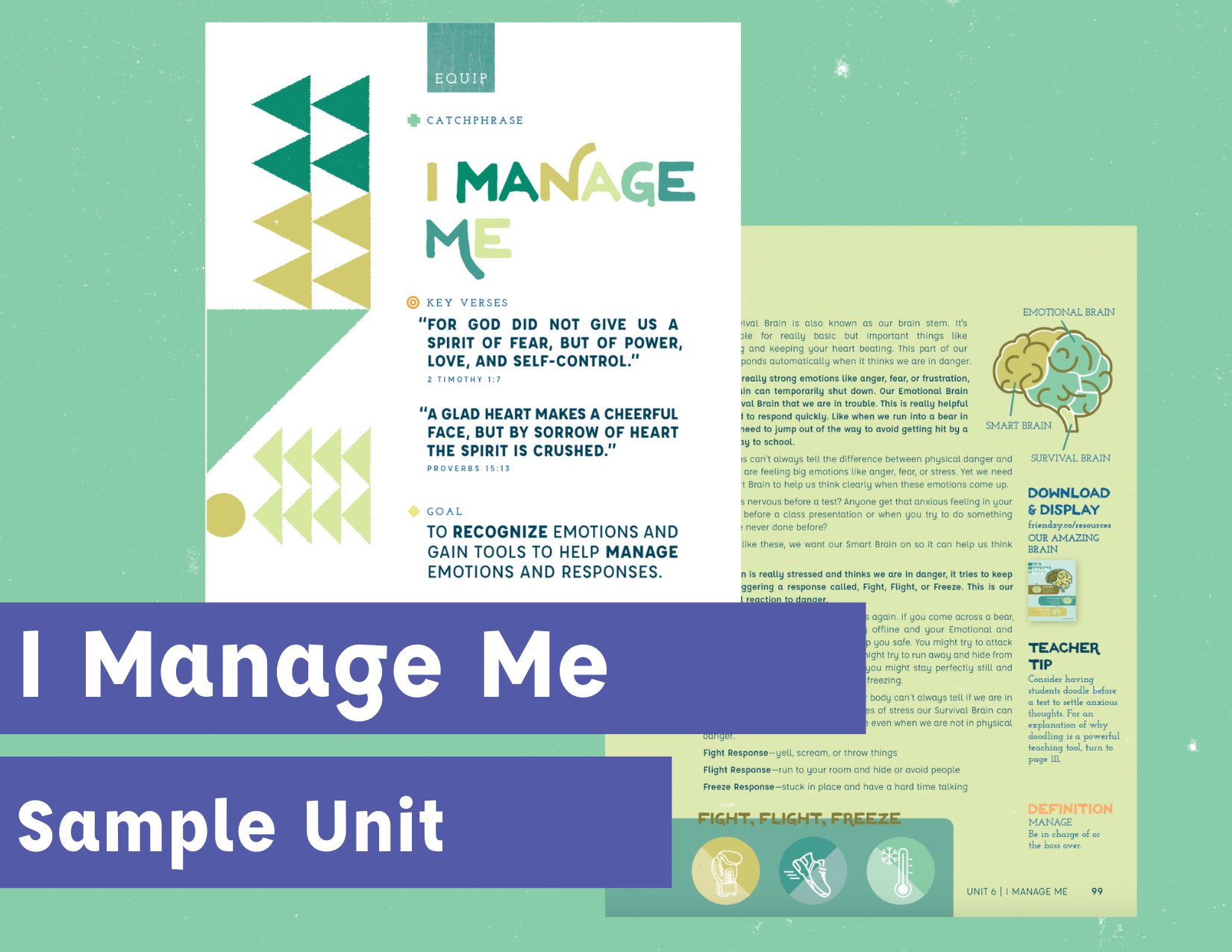
Teaching Part 1: Unit Overview - Use this lesson whole-group to introduce the topic and parts of the brain.
Teaching Part 2: Object Lesson - Get tactile in this object lesson that associates emotions with physical items of different textures.
Group Questions - Use these discussion questions to get students talking about real-life examples and reflecting on how they manage their emotions. Students can discuss in pairs, small groups, whole group, or independently reflect on any questions in the lesson. The More Mature Material section is geared towards middle school students.
Activity: Feelings Emojis - Activate students’ creativity with art supplies to create their own emojis.
Game: Paul AND Timothy - Students work in pairs to lead one another through an obstacle course to different emotion posters. Play this game when you have space for students to roam.
Even More - Practice faith in action in this lesson as students unpack James 1:19 in connection to managing one’s emotions.
BIO | Ali Suranovic Stoner - Friendzy Lead Content Developer

Ali Suranovic Stoner serves as Friendzy's Lead Content Developer and brings a deep passion for creating content that resonates with educators while being applicable to students. A former elementary teacher herself, she brings a wealth of real-world expertise to her role at Friendzy.
Additionally, Ali holds a Bachelors of Science Degree in Early Childhood Education from the University of Dayton and a Master of Education (MEd) in Teacher Leadership from Brandeis University.