In today’s digitally-focused world, where outside voices constantly shape how students measure success and worth, the steady, affirming voice of educators matters more than ever. Research shows that when children regularly hear feedback that names their strengths, they're more motivated, engaged, and willing to persevere even when learning feels hard.
We've curated thoughtful FREE resources educators and parents can use to promote and encourage building student strengths in and outside of the classroom.
 The Power of Everyday Language
Strength-based feedback doesn’t need to sound formal or scripted. It works best when it’s natural and specific. We simply call out what we see. Research shows that everyday affirming language from trusted adults builds confidence, motivation, and stronger relationships (Baron, 2023).
Kids don’t just want to hear that they did well. They want to know why it mattered.
Many of the things we say as parents are positive—but vague. For example:
“Good job.”
“You’re so smart.”
“You’re really good at basketball.”
“You’re a natural at this.”
Those feel good in the moment, but they don’t give kids much to hold onto. Try shifting to language that names effort, habits, or character:
“I noticed you stuck with that math problem even when it was frustrating. That’s perseverance.”
“You tried a few different ways to solve that. That shows problem-solving.”
“You practiced your shots even when no one was watching. That’s dedication.”
“You listened to your coach and adjusted. That shows humility.”
“You asked for help when you needed it. That takes courage.”
It’s a small shift—but a powerful one. Instead of labeling kids with fixed traits, you’re helping them see growth as something they participate in, using the gifts God has given them through effort and practice.
Over time, kids start to think, I can keep trying, I can learn from mistakes, and I have strengths I can grow. That mindset shows up everywhere from friendships, schoolwork, and in hard moments.
We've curated thoughtful FREE resources educators and parents can use to promote and encourage building student strengths in and outside of the classroom.

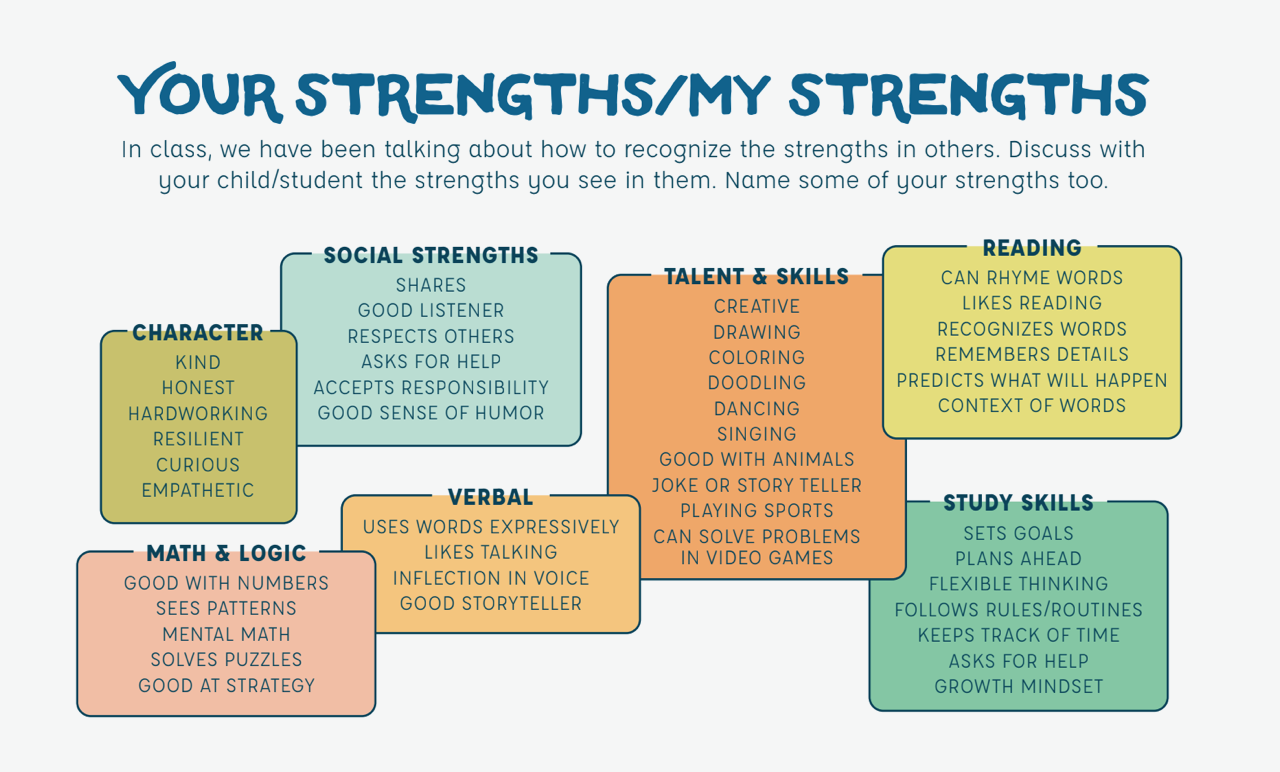
The Strengths Finder Chart | To support Christ-centered formation in everyday classroom moments, Friendzy created a kid-friendly Strengths Finder Chart designed especially for educators. It helps teachers notice, name, and celebrate the God-given strengths they see in students throughout the school day—from lessons and group work to transitions and discipline conversations.
Rooted in the belief that each child is uniquely created with purpose, the chart organizes strengths into clear, classroom-friendly categories, including:
Character: kindness, honesty, courage, curiosity
Learning habits: persistence, organization, goal-setting
Social skills: empathy, leadership, teamwork
Communication: listening, storytelling, creativity
Problem-solving: flexibility, logic, strategy
Talents & interests: artistic, musical, athletic, tech-savvy
Many educators keep the chart visible near desks, on whiteboards, or alongside lesson plans so it’s always within reach. Teachers often share that it helps shift classroom conversations toward grace and growth, reinforces students’ God-given identity, and makes strengths-based feedback both natural and meaningful—without adding one more thing to the to-do list.

Printable Poster | What Educators Say—and What Builds Confidence.
Words shape identity.
What we say every day becomes the voice our students hear in their heads when things get hard.
Scripture reminds us: “Encourage one another and build one another up.” (1 Thessalonians 5:11). Encouragement isn’t extra—it’s formative.

One of our favorite Friendzy strategies is a simple three-step approach that works beautifully for busy families:
Spot it.
Notice everyday moments when your child shows a strength. These moments are often small: sticking with a tough math problem, helping a sibling without being asked, or taking a deep breath instead of melting down.
Say it.
Name the strength clearly and connect it to what you observed.
“I saw you keep trying even when that was frustrating. That’s perseverance.”
Celebrate it.
Reinforce the moment with warmth including eye contact, a smile, a high five, a hug, or sharing the moment with another person like a grandparent. Celebration doesn’t need to be big; it just needs to be sincere.
This works because kids start connecting actions to identity. Over time, they think, I’m persistent or I’m kind, even when things don’t go perfectly.